


 Admin
Admin 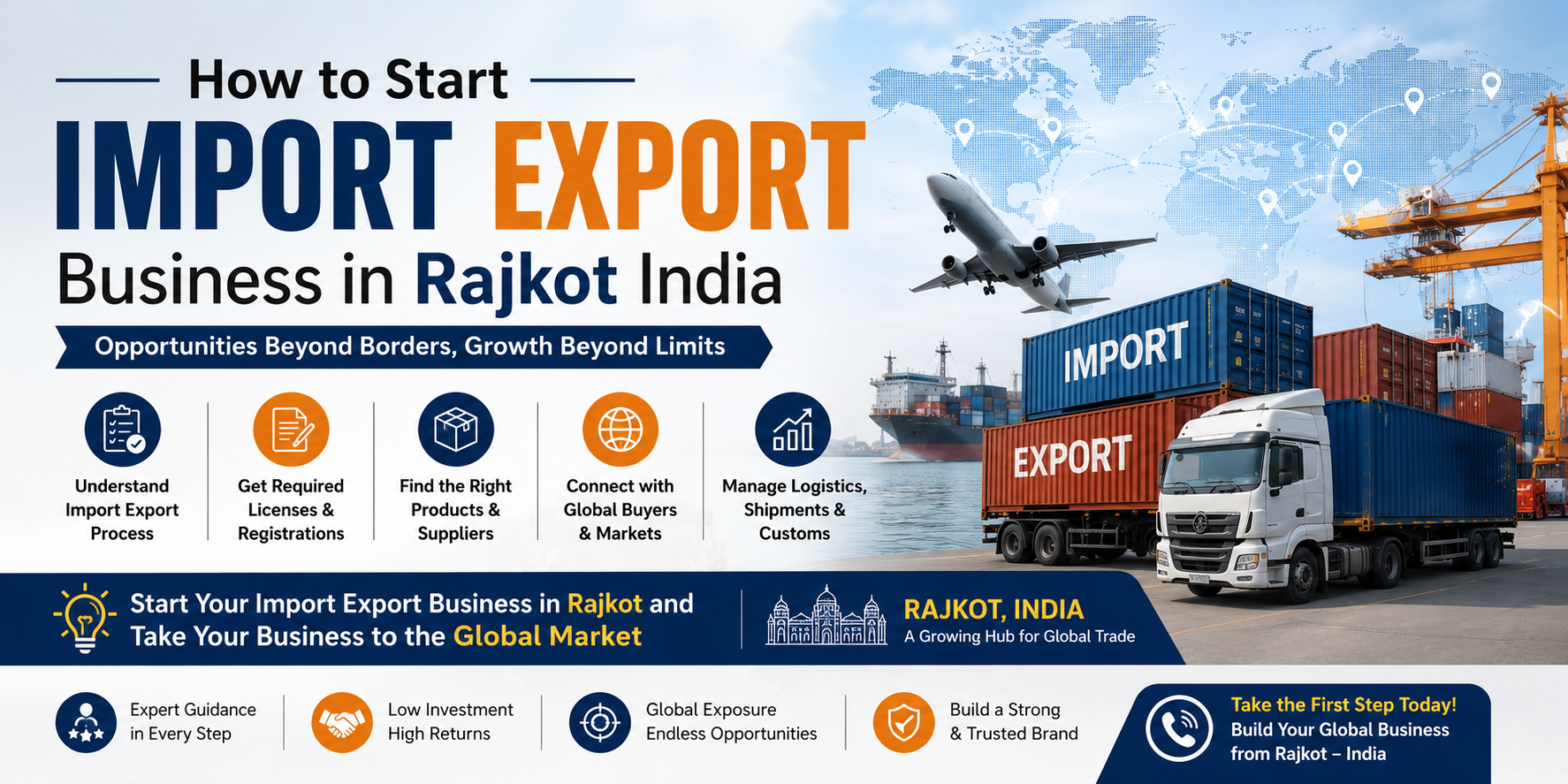
Rajkot, one of Gujarat’s fastest-growing commercial cities, has emerged as a fertile ground for entrepreneurs looking to tap into international trade. If you are based in Rajkot and wondering how to start an import export business in India, this guide covers every essential step — from legal registration to finding your first buyer or supplier abroad. Lime Institute, Rajkot’s leading import export training centre, has helped hundreds of students and entrepreneurs build profitable global trade businesses from scratch.
Why Rajkot Is an Ideal Base for Import Export Business
Rajkot’s industrial ecosystem includes engineering goods, brass parts, ceramics, textiles, and agricultural products — many of which are in strong demand in international markets. The city’s proximity to Kandla and Mundra ports in Gujarat gives exporters a logistical advantage over inland cities. For importers, Rajkot’s manufacturing base creates consistent demand for raw materials and machinery from overseas. Starting an import export business here is not just viable — it is strategically smart.
Step 1: Choose Your Product and Market
Before any registration, the most important decision is what you will trade and with which markets. Research is essential at this stage. Identify products with strong export demand from India — engineering goods, handicrafts, pharmaceuticals, agricultural commodities — or products with high import demand domestically, such as machinery, chemicals, and electronics. Study the HS code classification for your product, as this determines your customs duties and regulatory requirements.
Step 2: Register Your Business Entity
You need a registered business entity before applying for any trade licence. The most common structures for import export businesses in India are sole proprietorship, partnership firm, LLP (Limited Liability Partnership), or private limited company. For beginners in Rajkot, a proprietorship is the simplest starting point. Register under GST as well, since GST registration is mandatory for businesses engaged in interstate trade and exports.
Step 3: Obtain Your Import Export Code (IEC)
The IEC (Import Export Code) is the primary licence required to engage in any import or export activity in India. It is issued by the Directorate General of Foreign Trade (DGFT) and is a 10-digit PAN-linked number. The application is completely online at the DGFT portal and typically processed within 3 to 7 working days. There is no renewal required — the IEC is valid for the lifetime of the business.
At Lime Institute, our import export training programmes include a dedicated module on IEC application and DGFT portal navigation so students can complete this step confidently.
Step 4: Register with an Export Promotion Council (RCMC)
The RCMC (Registration Cum Membership Certificate) is issued by the relevant Export Promotion Council for your product category — EEPC India for engineering products, APEDA for agricultural products, CLE for leather, and so on. RCMC registration gives you access to government export incentives, schemes like MEIS/RoDTEP, and buyer databases maintained by the council.
Our RCMC registration guide walks through the exact process for the most common product categories exported from Rajkot and Gujarat.
Step 5: Open a Current Account with Export/Import Facilities
Your bank account needs to be equipped for foreign currency transactions. Open a current account with a bank that offers foreign exchange facilities and has a correspondent banking network. HDFC, ICICI, SBI, and Axis Bank all offer specialised trade finance services including Letter of Credit (LC), Bank Guarantee, and forward contracts for currency hedging.
Step 6: Find Buyers and Suppliers
Finding international buyers or suppliers is where many new traders struggle most. The primary channels are: B2B portals like IndiaMART, Alibaba, and TradeIndia; participation in international trade fairs such as those organised by ITPO and the relevant export promotion council; government buyer-seller meets; and direct outreach through LinkedIn and industry associations.
Lime Institute’s B2B and B2C buyer list resource gives students access to curated international buyer databases relevant to key export categories from Gujarat.
Step 7: Understand Documentation and Logistics
Export-import business involves a specific set of documents for every shipment: the commercial invoice, packing list, bill of lading or airway bill, certificate of origin, GST invoice, shipping bill (for exports), and bill of entry (for imports). Understanding each document’s purpose and how to prepare it correctly is critical to clearing customs without delays and penalties.
Enrol in our import export business course in Rajkot to master all documentation, Incoterms, customs procedures, and payment terms in a structured, practical curriculum. Our programmes are designed for complete beginners as well as professionals looking to formalise their trade knowledge.
Start Your Import Export Business in Rajkot with Lime Institute
Lime Institute has trained over a thousand students and entrepreneurs from Rajkot, Ahmedabad, Surat, and across Gujarat in the practical skills required to build a successful import export business. Our courses cover everything from IEC registration to finding buyers, negotiating contracts, and managing foreign currency risk. Explore our current course offerings and take the first step toward building your global trade business from Rajkot today.