


 Admin
Admin 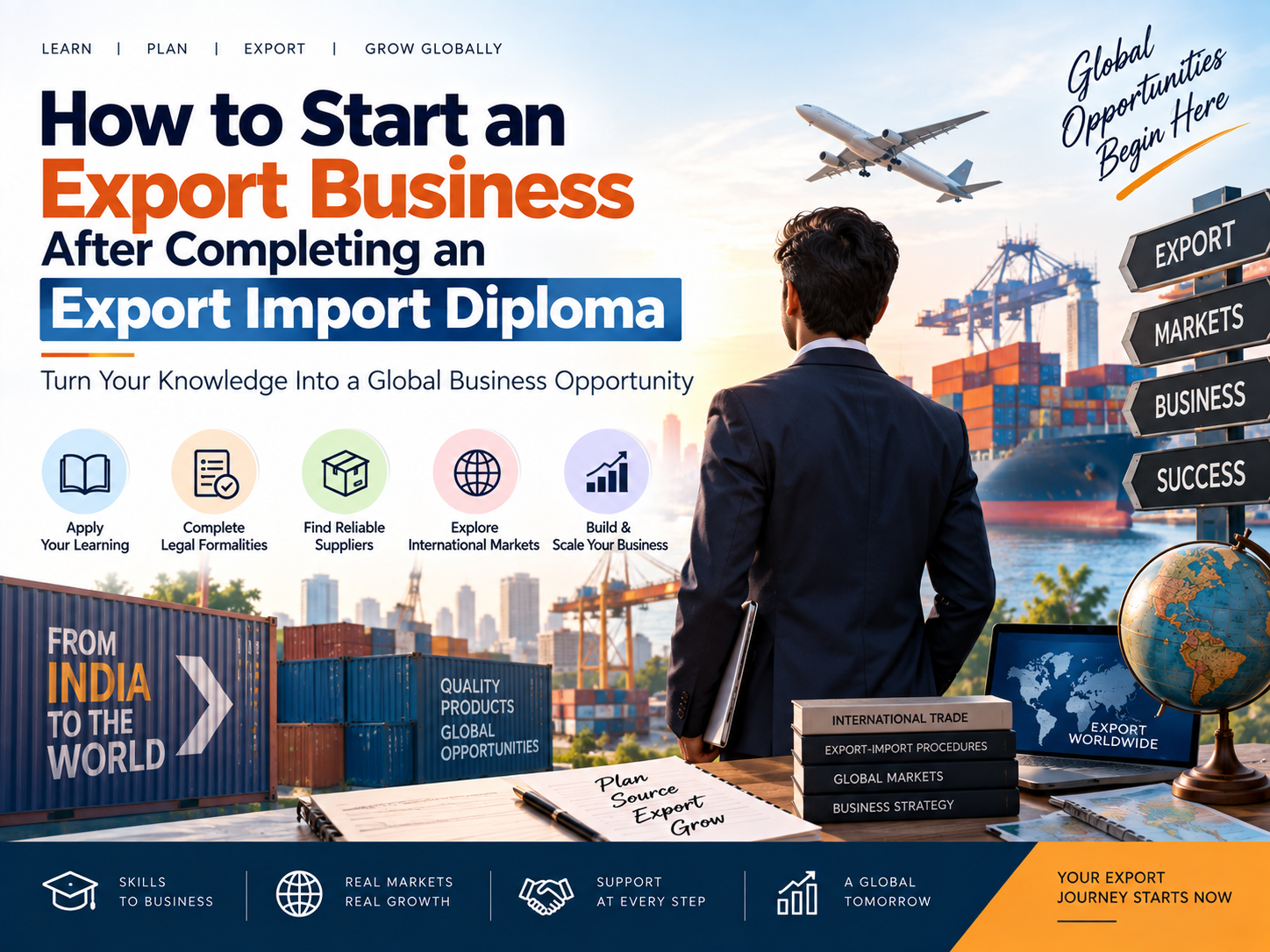
Completing an Export Import Diploma is a powerful first step — but what comes next? For many graduates, the real challenge begins after the classroom: turning that knowledge into a functioning, profitable export business. The good news is that India’s export sector is booming, and the skills you have acquired through a professional export import course give you a genuine competitive advantage. This guide walks you through exactly how to start an export business after completing your diploma.
Step 1: Define Your Export Niche and Product
Your first decision is identifying what you want to export. This is not simply about choosing a product you like — it requires market research, demand analysis and understanding of international trade regulations. Consider factors like India’s current export strengths (textiles, engineering goods, pharmaceuticals, handicrafts, food products), global demand trends, competition in your target market and your access to reliable suppliers.
Your export import diploma training will have introduced you to trade data tools like DGFT, APEDA, FIEO and platforms like Zauba and Trademap — use these to identify high-demand products with strong margins and growing international interest.
Step 2: Register Your Business and Obtain an IEC
To legally export from India, you need an Import Export Code (IEC) — a ten-digit code issued by the Directorate General of Foreign Trade (DGFT). This is the most fundamental registration for any export business. The process is largely online and straightforward if you have your business registration, PAN and bank details ready.
Beyond IEC, you may also need GST registration, RCMC (Registration-cum-Membership Certificate) from an Export Promotion Council relevant to your product sector, and in some cases specific product licences. At Lime Institute, we cover all of these processes in depth in our how to start an import export business guide. You can also explore our RCMC registration guidance for step-by-step support.
Step 3: Identify and Qualify International Buyers
Finding buyers is one of the most practical skills an export import diploma teaches you. Your options include:
- B2B Platforms – Alibaba, IndiaMART, TradeIndia, Global Sources and Amazon Global Selling are excellent starting points for connecting with international buyers
- Export Promotion Councils – Bodies like FIEO, APEDA, EEPC India and CII regularly facilitate buyer-seller meets and trade delegations
- Trade Fairs and Exhibitions – Participating in international trade fairs (or India pavilions at overseas fairs) gives you direct access to serious buyers
- Cold Outreach – With a strong product catalogue, website and email pitch, direct outreach to international distributors and retailers can be highly effective
Our B2B and B2C buyer list resource provides a comprehensive directory of platforms and organisations to accelerate your buyer search.
Step 4: Understand Export Documentation and Costing
One of the areas where export import diploma graduates have a clear advantage is in understanding the documentation required for international shipments — commercial invoice, packing list, bill of lading or airway bill, certificate of origin, shipping bill and more. Getting documentation right is critical; errors can result in customs delays, penalties and lost orders.
Equally important is accurate export costing and pricing. Your price must account for production or procurement cost, packaging, inland freight, customs clearance, freight forwarding, insurance, banking charges and your profit margin — all while remaining competitive internationally. Review our export costing and price calculation guide for a practical framework.
Step 5: Set Up Logistics and Payment Terms
Selecting the right freight forwarder, understanding Incoterms (FOB, CIF, EXW, etc.) and negotiating payment terms with buyers are essential operational skills. For new exporters, safer payment methods like Letters of Credit (LC) or advance payment via wire transfer are recommended. As your relationships with buyers develop, you may move to more flexible terms like Documents Against Payment (DP) or credit arrangements.
Many diploma graduates find this stage — translating classroom knowledge into real logistics decisions — the most challenging. Our import export classes at Lime Institute include practical case studies to prepare you for exactly these scenarios.
The Opportunity Ahead
India’s export target of $2 trillion by 2030 means there has never been a better time to enter the export business. Government schemes like RoDTEP, MEIS successors, the PLI scheme and the Export Credit Guarantee Corporation (ECGC) provide significant support to new exporters. With your export import diploma, you have the foundational knowledge — now it is time to act.
Explore the full range of export opportunities available in India and discover how Lime Institute’s training can help you move from diploma graduate to successful exporter. Our job-oriented import export courses are designed specifically to bridge this gap between learning and doing.